
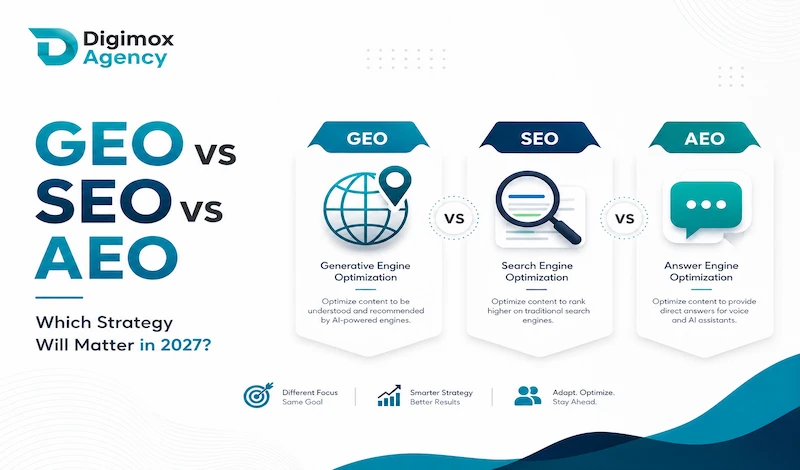
If you have spent any time in a marketing meeting this year, you have probably heard someone throw around GEO vs SEO vs AEO like everyone already knows what it means. Most people do not. And that confusion is costing businesses real visibility.
Search is changing faster than at any point in the last two decades. Google now answers questions directly on the results page. ChatGPT, Perplexity, and Gemini generate full answers without a single click to your website. Voice assistants read out summaries instead of listing ten blue links. In the middle of all this, marketers are asking the same question: GEO vs SEO vs AEO, which one actually deserves the budget?
This article breaks down GEO vs SEO vs AEO in plain language, compares how each discipline works, and gives you a practical roadmap for building a search strategy that survives into 2027 and beyond. Whether you run an in-house marketing team or you are evaluating agencies for your next campaign, this guide will help you make sense of the noise.
What Is SEO (Search Engine Optimization)
Search Engine Optimization is the practice of improving a website so it ranks higher in traditional organic search results. SEO has existed since the late 1990s and remains the foundation of digital visibility.
Search engine optimization trends have shifted many times, from keyword density in the early 2000s, to backlinks in the 2010s, to helpful content and topical authority today. But the core goal has never changed: match search intent, build trust, and earn a spot on the search engine results page.
Modern SEO includes several layers:
- On-page SEO: title tags, headers, internal linking, content optimization
- Technical SEO: site speed, mobile usability, crawlability, structured data
- Off-page SEO: backlinks, brand mentions, digital PR
- Local SEO: Google Business Profile optimization, local citations, map pack rankings
SEO in 2027 will still matter, but its role is shifting from being the only channel to being one layer inside a larger AI search optimization stack.
What Is AEO (Answer Engine Optimization)
Answer Engine Optimization focuses on getting your content selected as the direct answer to a user’s question. This includes featured snippets, People Also Ask boxes, voice search results, and the short answer boxes that appear above traditional listings.
AEO became critical the moment Google introduced featured snippets and voice assistants started reading single answers aloud instead of listing options. Answer Engine Optimization is built around:
- Clear, concise answers to specific questions
- FAQPage and HowTo schema markup
- Structured, scannable formatting (numbered lists, short paragraphs)
- Matching natural language queries and conversational search patterns
AEO in 2027 is expected to expand well beyond snippets, covering how AI assistants pull short, quotable answers from your content during conversational search sessions.
What Is GEO (Generative Engine Optimization)
Generative Engine Optimization is the newest of the three, and the one causing the most confusion. GEO is the practice of optimizing content so it gets cited, summarized, or referenced by generative AI tools such as ChatGPT search, Google AI Overviews, Perplexity, and Gemini.
Unlike traditional SEO, GEO is not about ranking on a page of ten links. It is about becoming a trusted source that an AI model chooses to pull from when generating a conversational answer. GEO strategy 2027 will likely revolve around:
- Entity optimization: making sure your brand, products, and expertise are clearly defined and easy for AI models to understand
- Structured data and schema markup that machines can parse accurately
- Original data, research, and citations in AI search results
- Strong topical authority across a subject, not just isolated keywords
- Brand mentions across the web that reinforce credibility to large language models
GEO strategy 2027 is less about manipulating rankings and more about earning trust signals that generative AI engines recognize as authoritative.
GEO vs SEO: Core Differences
When people compare GEO vs SEO, the biggest difference comes down to the destination. SEO sends users to your website through a list of links. GEO influences whether an AI model summarizes or cites your content directly inside its generated answer, often without any click at all.
| Factor | SEO | GEO |
| Goal | Rank on the SERP | Get cited in AI-generated answers |
| Traffic result | Click-through to website | Often zero-click, brand exposure only |
| Ranking factor | Backlinks, keywords, technical SEO | Entity clarity, structured data, authority |
| Measurement | Rankings, organic traffic | Citations, brand mentions, AI visibility |
| Content style | Keyword-optimized pages | Well-structured, fact-dense, quotable content |
GEO vs SEO is not really a battle between two competing tactics. It is a shift in where the competition happens. SEO still gets you found. GEO determines whether AI tools trust you enough to quote you.
5. SEO vs AEO: Core Differences
SEO vs AEO is a narrower comparison because AEO grew directly out of SEO practices. The main difference is intent and format.
SEO optimizes for broad visibility across many search terms. AEO optimizes for one specific outcome: being chosen as the direct answer to a single, well-defined question.
- SEO targets ranking positions 1 through 10 for a keyword
- AEO targets position zero, the answer box above all organic results
- SEO content can be long and exploratory
- AEO content must be short, direct, and immediately useful
A strong SEO in 2027 approach still needs AEO principles baked in, because Google increasingly pulls answer boxes from pages that also rank well organically. They reinforce each other rather than compete.
GEO vs AEO: Core Differences
GEO vs AEO is where most marketers get confused, because both deal with getting a “direct answer” in front of users without a traditional click. The difference lies in the source of the answer.
AEO optimizes content to be selected by a search engine’s answer box, a feature still tied to the traditional search engine results page. GEO optimizes content to be selected, synthesized, and cited by a generative AI model that may combine information from multiple sources into one original response.
- AEO answers are extracted almost word-for-word from a single source
- GEO answers are often synthesized from several sources, with your brand potentially mentioned as one of many
- AEO relies heavily on schema markup and FAQ formatting
- GEO relies heavily on topical authority, entity optimization, and being referenced across the wider web, not just your own domain
Understanding GEO vs AEO helps businesses realize they need different tactics for two very different AI-driven surfaces.
GEO vs SEO vs AEO: Side-by-Side Comparison
Here is the full GEO vs SEO vs AEO comparison in one table, useful as a quick reference when planning your search optimization trends strategy for 2027.
| Dimension | SEO | AEO | GEO |
| Primary platform | Google, Bing organic results | Featured snippets, voice search, PAA | AI Overviews, ChatGPT search, Perplexity, Gemini |
| Core objective | Rank high on the SERP | Become the direct answer | Get cited inside AI-generated responses |
| Traffic type | Organic clicks | Zero-click with brand visibility | Mostly zero-click, citation-based visibility |
| Key tactics | Keywords, backlinks, technical SEO | Schema markup, concise answers, FAQ formatting | Entity optimization, structured data, topical authority |
| Content format | Long-form, comprehensive pages | Short, direct, scannable answers | Fact-dense, well-sourced, quotable content |
| Measurement | Rankings, organic sessions | Snippet ownership, voice mentions | AI citations, brand mentions, referral share |
| Growth trajectory to 2027 | Stable but declining click share | Expanding across voice and mobile | Fastest-growing, tied to generative AI adoption |
This comparison table makes one thing clear. GEO vs SEO vs AEO is not a competition between three separate strategies fighting for the same budget. It is three layers of the same modern search optimization stack, and businesses that treat them as separate silos will fall behind in AI search in 2027.
Why This Debate Matters More in 2027
By 2027, industry forecasts suggest a large share of informational searches will be resolved without a single click to a website. Google AI Overviews already appear on a significant percentage of search queries, and adoption is only accelerating as Google AI search matures.
Every conversation about GEO vs SEO vs AEO eventually comes back to budget allocation, and this is why the GEO vs SEO vs AEO conversation has moved from a theoretical debate to a budget-line decision. Businesses that only invest in classic SEO risk losing visibility as more queries get answered directly inside AI Overviews or AI chat interfaces. Businesses that only chase GEO risk ignoring the fact that traditional organic search still drives the majority of measurable, trackable traffic today.
The smartest agencies are not picking a side in GEO vs SEO vs AEO. They are building integrated strategies that account for all three, because AI search engines and traditional search engines are increasingly pulling from the same underlying signals: structured content, topical authority, and trustworthy sources.
How AI Search Engines Are Changing Google Search 2027
Google search 2027 will look meaningfully different from search today. Several shifts are already underway:
- AI Overviews expanding to more query types, including transactional and local searches
- Conversational search sessions where users ask follow-up questions instead of typing new keywords
- Multimodal search, combining text, voice, and image input
- Increased weight on E-E-A-T as Google tries to filter low-quality, AI-generated spam out of AI Overviews
- Zero-click searches becoming the default outcome for a growing share of informational queries
AI-powered search is not replacing traditional search overnight. Instead, it is layering generative answers on top of the existing search engine results page, which means SERP visibility now depends on both classic rankings and AI-generated answer quality.
Building a Unified Strategy: SEO, GEO, and AEO Together
Rather than treating SEO strategy 2027, GEO strategy 2027, and AEO strategy 2027 as separate projects, the most effective approach blends all three into one content and technical framework.
Step 1: Build Topical Authority First
Search intent research should map out entire topic clusters, not isolated keywords. Topical authority is the foundation that both AI Overviews and traditional rankings reward.
Step 2: Structure Content for Machines and Humans
Use clear headings, short paragraphs, bullet points, and direct answers near the top of each section. This satisfies AEO requirements while improving readability for human visitors.
Step 3: Add Schema Markup Everywhere It Fits
FAQPage schema, HowTo schema, and Article schema help both traditional search engines and generative AI models understand your content accurately.
Step 4: Strengthen Entity Signals
Make sure your brand, founders, and expertise are consistently described across your website, social profiles, directories, and third-party mentions. This is the backbone of entity optimization and directly supports GEO.
Step 5: Earn Citations and Brand Mentions Beyond Your Own Site
GEO rewards brands that appear across multiple credible sources, not just their own domain. Digital PR, guest content, and industry directories all contribute to citations in AI search.
Step 6: Keep Technical SEO Clean
Site speed, mobile usability, and crawlability remain non-negotiable. AI crawlers and traditional search bots both need clean, accessible websites to index and understand content correctly.
Technical Foundations Every Strategy Shares
Regardless of where you land in the GEO vs SEO vs AEO debate, certain technical foundations support all three disciplines equally:
- Fast, mobile-friendly websites
- Clean URL structures and logical site architecture
- Structured data and schema markup across key pages
- Secure, crawlable, well-indexed pages
- Internal linking that reinforces topical relationships
Skipping technical SEO does not just hurt organic rankings. It also limits how well AI crawlers can parse and trust your content, which directly affects your GEO performance.
Content Quality, E-E-A-T, and People-First Content
Google’s helpful content guidance and E-E-A-T framework (Experience, Expertise, Authoritativeness, Trustworthiness) apply across SEO, AEO, and GEO alike. AI Overviews and generative engines are specifically designed to filter out thin, unoriginal, or purely AI-generated content that lacks real expertise.
People-first content wins across all three disciplines because it demonstrates:
- First-hand experience with the topic
- Clear expertise, often backed by author credentials
- Authoritative sourcing and original insight
- Trustworthy, transparent, fact-checked information
Content quality is no longer optional. It is the single biggest differentiator between brands that get cited by AI search engines and brands that get ignored.
Measuring Success Across GEO, SEO, and AEO
Traditional SEO metrics like rankings and organic traffic still matter, but they no longer tell the full story. A modern measurement framework should include:
- SEO metrics: keyword rankings, organic sessions, backlink growth
- AEO metrics: featured snippet ownership, voice search appearances, PAA visibility
- GEO metrics: brand mentions in AI Overviews, citation frequency in ChatGPT search and Perplexity, referral traffic from AI platforms
Several emerging tools now track AI search visibility specifically, giving marketers a clearer picture of how often their brand appears inside generative AI answers, even when that visibility does not translate into a direct website click.
Common Mistakes Businesses Make
- Treating GEO vs SEO vs AEO as an either-or decision instead of a combined strategy
- Ignoring schema markup because it feels like a low-priority technical task
- Publishing thin content purely to hit a keyword quota
- Failing to build topical authority around a niche before chasing rankings
- Assuming AI search optimization is a passing trend instead of the next phase of search
- Not tracking brand mentions and citations outside their own website
Future of Search: What to Expect Beyond 2027
Looking past 2027, expect the line between SEO, AEO, and GEO to blur even further. Search engines and generative AI models are converging toward one unified experience where users ask questions in natural language and receive synthesized, sourced answers instantly.
The future of SEO is not the end of SEO. It is an evolution where visibility depends on being trustworthy enough, structured enough, and authoritative enough to be chosen by both algorithms and AI models. Brands that build strong topical authority, clean technical foundations, and genuine expertise today will be well positioned no matter how the GEO vs SEO vs AEO balance shifts in the years ahead.
Conclusion
The GEO vs SEO vs AEO question keeps coming up because every business wants to know where to spend its next marketing dollar. The GEO vs SEO vs AEO conversation is not about picking a winner. It is about recognizing that search has split into three interconnected layers: traditional rankings, direct answers, and AI-generated citations. Businesses that build topical authority, invest in technical SEO, structure content for both humans and machines, and actively manage their presence across AI search engines will be the ones that stay visible through 2027 and beyond. GEO vs SEO vs AEO ultimately comes down to building one integrated, trustworthy digital presence that performs across every surface where your audience searches.
Call to Action
If you want a search strategy built for where Google search 2027 and AI-powered search are actually heading, DigiMox Agency can help you combine SEO, AEO, and GEO into one integrated plan. Visit digimoxagency.com to get a free audit of your current search visibility across traditional and AI-driven platforms.