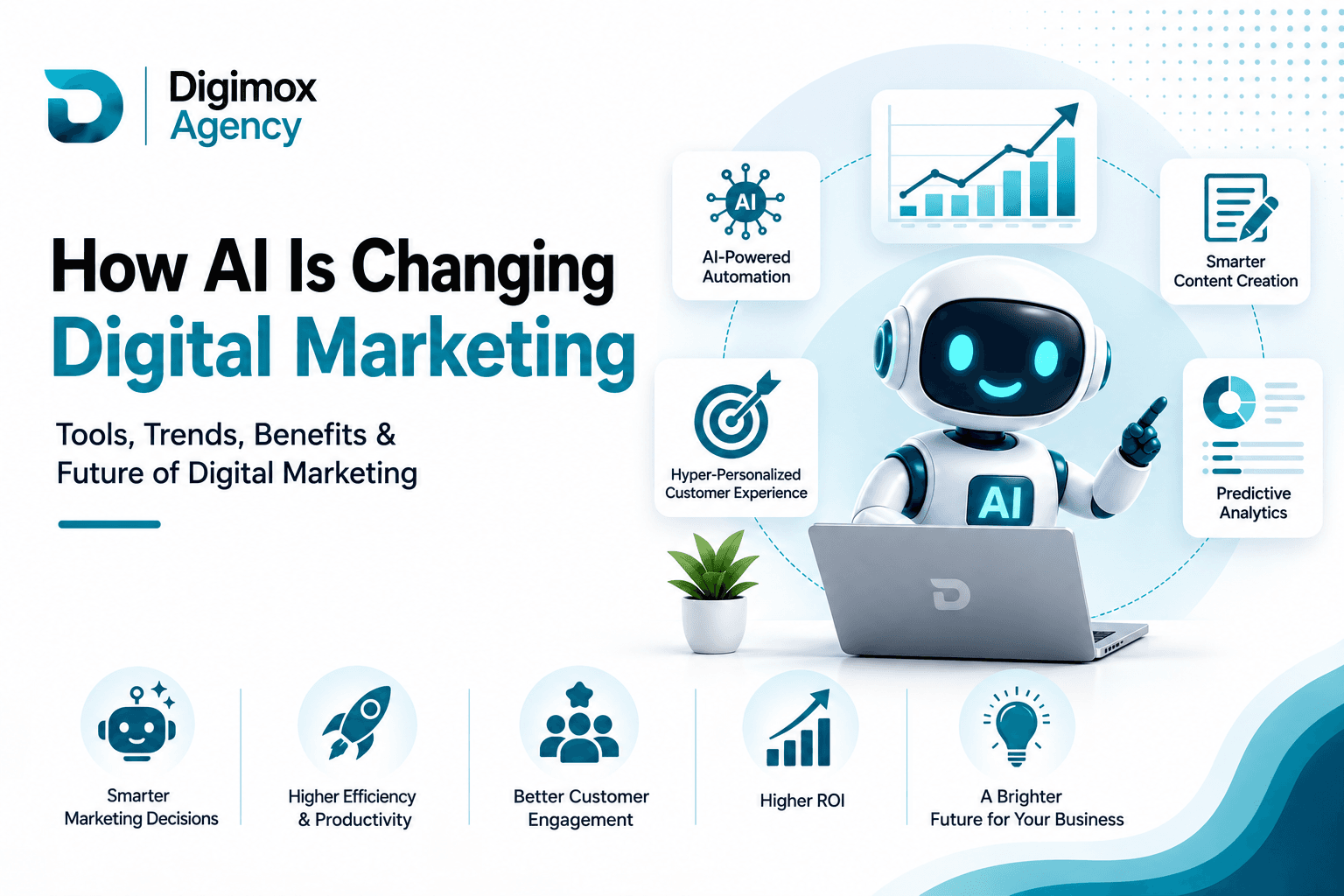
Marketing has never moved this fast. Every quarter brings a new tool, a new algorithm update, and a new way for brands to reach customers. At the center of this shift sits one force reshaping everything: AI in Digital Marketing. What used to take a team of five specialists a copywriter, an SEO analyst, a data scientist, a designer, and a media buyer can now be handled, in large part, by a single marketer working alongside smart software.
This isn’t a passing trend. AI in Digital Marketing has moved from an experimental add-on to the operating system of modern campaigns. Brands that understand this shift are pulling ahead. Brands that ignore it are quietly falling behind, wondering why their cost-per-lead keeps climbing while competitors scale faster on smaller budgets.
This guide walks through exactly how AI in Digital Marketing works today, which tools are worth your time, the real benefits businesses are seeing, and where this is all heading next. Whether you run a five-person startup or manage marketing for an established brand, you’ll walk away with a practical understanding of how to use AI in Digital Marketing without losing the human judgment that makes marketing actually work.
What Is AI in Digital Marketing?
AI in Digital Marketing refers to the use of artificial intelligence, machine learning, and generative AI technologies to plan, create, distribute, and optimize marketing activities. Instead of a marketer manually digging through spreadsheets to spot patterns, AI systems process massive volumes of data in seconds and surface insights that would otherwise take days to find.
At its core, artificial intelligence in marketing runs on a few key technologies:
- Machine Learning systems that learn from historical data to predict outcomes, like which email subject line will get more opens.
- Generative AI tools that create new content, from blog drafts to product images, based on prompts.
- Predictive Analytics models that forecast customer behavior, churn risk, or campaign performance before it happens.
- Conversational AI chatbots and virtual assistants that handle customer queries in real time.
Put together, these technologies form the backbone of modern MarTech (marketing technology) stacks. AI in Digital Marketing isn’t one tool it’s a layer of intelligence woven into SEO platforms, ad networks, email software, and social media schedulers alike.
Why AI in Digital Marketing Matters Right Now
A decade ago, digital marketing mostly meant a website, a few social media accounts, and maybe a Google Ads campaign. Today, the average customer journey touches search engines, social platforms, email, retargeting ads, and chat widgets often within a single afternoon. Tracking and optimizing across that many touchpoints manually simply isn’t realistic anymore.
This is exactly the gap AI in Digital Marketing fills. It processes signals across every channel at once a visitor’s search behavior, their social engagement, their email open history and turns that scattered data into one coherent picture. That single view is what makes modern data-driven marketing possible, and it’s why so many teams have shifted their entire operating model around it.
The Building Blocks of Modern MarTech
Every AI-powered marketing stack, whether built for a five-person startup or a national retailer, tends to rely on a similar set of building blocks:
- Data collection layer Google Analytics 4 (GA4), Google Search Console, and CRM systems that gather raw behavioral data.
- Intelligence layer machine learning models that turn that raw data into predictions and recommendations.
- Execution layer the actual tools (email platforms, ad managers, content editors) that act on those recommendations.
Understanding this three-layer structure makes it much easier to evaluate any new AI marketing software that comes on the market. The real question isn’t “does it use AI?” nearly everything claims that now but “which layer does it improve, and does that layer actually matter for my business?”
How AI Is Changing Digital Marketing
Ask any marketer who’s been in the industry for over a decade, and they’ll tell you: the job looks completely different now. Here’s how AI is changing digital marketing at a practical level.
From guesswork to data-driven marketing. Marketers used to rely on intuition and A/B testing that took weeks to produce results. Now, predictive analytics models can simulate outcomes before a campaign even launches, making data-driven marketing the default rather than the exception.
From generic to personalized. AI customer personalization engines analyze browsing history, purchase patterns, and engagement signals to tailor content for each visitor. A returning customer might see different homepage banners than a first-time visitor automatically.
From manual to automated. Tasks that once ate up hours scheduling posts, tagging leads, segmenting email lists now run on marketing automation rules that trigger themselves based on user behavior.
From static to conversational. AI chatbots for marketing now qualify leads, answer FAQs, and even book appointments, all without a human on the other end during off-hours.
From reactive to predictive. Instead of reacting to a drop in conversions after the fact, AI analytics tools flag anomalies and forecast trends, giving marketers a chance to adjust before performance suffers.
This transformation touches every corner of the customer journey awareness, consideration, conversion, and retention which is exactly why understanding AI in Digital Marketing has become non-negotiable for anyone serious about growth.
Best AI Tools for Digital Marketing
There’s no shortage of software claiming to be “AI-powered” today. Here are the tools that have earned their place in serious marketing workflows.
Content and Copywriting
- ChatGPT widely used for brainstorming, drafting blog outlines, generating ad copy variations, and answering research questions quickly.
- Claude known for longer-form writing, nuanced tone control, and handling detailed briefs like this one with strong instruction-following.
- Gemini Google’s AI assistant, useful for content ideation and tasks that benefit from tight integration with Google’s ecosystem, including Search and Workspace.
- Jasper built specifically for marketing teams, with brand voice templates and campaign-focused workflows.
SEO and Content Optimization
- Semrush a full SEO suite offering keyword research, competitor gap analysis, and AI-assisted content templates.
- Ahrefs strong for backlink analysis, keyword difficulty scoring, and technical SEO audits.
- Surfer SEO focuses on on-page content optimization, scoring articles against top-ranking competitors in real time.
Design and Visual Content
- Canva its Magic Design and AI image tools let non-designers produce social graphics, ad creatives, and presentations quickly.
Email and CRM
- Mailchimp uses AI to recommend send times, generate subject lines, and segment audiences automatically.
- HubSpot combines CRM, email, and content tools with AI-driven lead scoring and workflow automation.
Social Media Management
- Hootsuite offers AI-generated caption suggestions and optimal posting time recommendations.
- Buffer simplifies scheduling with AI-assisted content suggestions across platforms.
Together, these represent some of the best AI marketing tools available today, each solving a different piece of the digital marketing puzzle. No single tool does everything well — the smartest teams combine two or three that fit their workflow rather than chasing every new release.
AI for SEO and Content Marketing
AI for SEO has fundamentally changed how content gets researched, written, and optimized. Tools like Semrush and Ahrefs now surface keyword clusters, search intent classifications, and content gaps almost instantly work that used to require hours of manual research.
AI content marketing tools also assist with:
- Generating topic clusters based on search intent
- Drafting meta titles and meta descriptions at scale
- Identifying underperforming pages that need a content refresh
- Suggesting internal linking opportunities based on semantic relevance
- Structuring content for AEO (Answer Engine Optimization) and featured snippets
AI copywriting has made first drafts faster, but the highest-performing content still involves a human editor refining tone, adding real expertise, and injecting the kind of first-hand experience that search engines increasingly reward under EEAT (Experience, Expertise, Authoritativeness, Trustworthiness) guidelines. AI in Content Creation works best as a collaborator, not a replacement it handles structure and speed, while people provide judgment and originality.
Technical SEO has benefited too. AI-powered crawlers can flag broken links, duplicate content, and indexing issues across thousands of pages in minutes, something that once required a dedicated technical audit.
AI for Social Media Marketing
AI for social media marketing helps brands stay consistent without burning out their teams. Platforms like Hootsuite and Buffer use machine learning to recommend the best times to post based on when a specific audience is most active not generic industry averages.
Generative AI also helps with:
- Drafting caption variations for A/B testing
- Repurposing long-form content into short social snippets
- Analyzing comment sentiment to catch PR issues early
- Identifying trending hashtags and formats within a niche
Customer segmentation tools built into social platforms now let brands target audiences based on granular behavioral data, improving both brand awareness and engagement rates simultaneously.
AI for Email Marketing Campaigns
Email remains one of the highest ROI marketing channels, and AI email marketing tools have made it smarter. Mailchimp, for example, uses predictive analytics to determine the optimal send time for each subscriber individually, rather than blasting an entire list at once.
Other capabilities now standard in AI-powered marketing platforms include:
- Automated subject line testing based on historical open rates
- Dynamic content blocks that change based on subscriber behavior
- Churn prediction models that flag customers likely to unsubscribe
- Automated re-engagement sequences for inactive segments
These features turn a static email calendar into a responsive system that adjusts to real customer behavior a clear example of marketing automation done right.
AI in Advertising and PPC
AI PPC advertising has quietly taken over bid management on platforms like Google Ads and Meta Ads. Machine learning models now adjust bids in real time based on the likelihood of conversion, a job that used to require constant manual monitoring.
AI advertising also powers:
- Automated audience targeting based on lookalike modeling
- Creative testing that rotates ad variations based on performance
- Budget allocation across campaigns to maximize return on investment (ROI)
- Fraud detection to filter out bot traffic and low-quality clicks
For businesses running performance marketing campaigns, this shift means fewer hours spent tweaking bids manually and more time spent on strategy and creative direction arguably a better use of a marketer’s time.
Getting the Most Out of AI-Driven Ad Platforms
Automated bidding works best when it’s given clear signals to optimize toward, not just left to run on default settings. Teams that see the strongest results from AI advertising tend to follow a few consistent habits:
- Feed the platform quality conversion data. If a Google Ads or Meta Ads account is only tracking clicks instead of actual sales or qualified leads, the AI has nothing meaningful to optimize toward.
- Give campaigns time to learn. Automated bidding models typically need a learning period often one to two weeks before performance stabilizes, so judging results too early can lead to premature, costly changes.
- Test creative regularly. Even the smartest bidding algorithm can’t fix an ad that isn’t resonating, so pairing AI advertising with fresh creative testing remains essential.
- Set guardrails, not just goals. Defining a maximum acceptable cost per acquisition keeps automated systems from chasing volume at the expense of profitability.
Treated this way, AI PPC advertising becomes less of a black box and more of a responsive partner one that still needs a marketer setting the direction and checking the guardrails.
Benefits of AI in Digital Marketing
The benefits of AI in Digital Marketing go beyond simple time savings. Here’s what businesses are actually gaining:
- Speed campaigns that once took weeks to plan and launch can go live in days.
- Personalization at scale AI customer personalization makes it possible to tailor messaging to thousands of individual users simultaneously.
- Better lead generation AI for lead generation tools score and prioritize leads based on real engagement signals, not gut feeling.
- Cost efficiency automated bidding and audience targeting reduce wasted ad spend.
- Improved customer engagement AI chatbots and personalized content keep customers engaged across the entire sales funnel.
- Sharper insights AI analytics tools surface patterns in customer behavior that manual reporting often misses.
- Consistency marketing automation ensures no lead falls through the cracks due to human oversight.
Businesses that adopt AI in Digital Marketing early often see faster growth simply because they can test more ideas, in less time, with better data behind each decision.
Measuring the Real ROI of AI in Marketing
None of these benefits matter much if they can’t be measured. The good news is that AI-powered platforms tend to make measurement easier, not harder, because they generate performance data automatically as campaigns run.
When evaluating whether an AI marketing tool is actually paying off, most teams track a similar set of marketing KPIs:
- Cost per lead and cost per acquisition does automated bidding actually lower these numbers over a full quarter, not just a single week?
- Time saved per task how many hours does a content calendar or email sequence take now versus before automation?
- Engagement lift are personalized emails and social posts driving measurably higher click-through and open rates?
- Conversion rate optimization (CRO) impact are AI-driven landing page tests producing statistically meaningful gains?
Tracking these numbers consistently, ideally inside Google Analytics 4 alongside platform native dashboards, keeps AI adoption grounded in results rather than novelty. A tool that sounds impressive but doesn’t move any of these KPIs after a reasonable testing period usually isn’t worth keeping in the stack.
AI Marketing Automation Explained
Marketing automation isn’t new, but AI has made it dramatically smarter. Traditional automation followed rigid if-this-then-that rules. AI marketing automation, by contrast, learns and adjusts.
For example, instead of sending the same follow-up email to every lead three days after signup, an AI system might:
- Send it after two days to leads showing high engagement
- Delay it for leads who haven’t opened previous emails
- Swap in different content based on which product pages a lead visited
This kind of adaptive automation touches the entire customer journey from the first ad click to post-purchase retention emails and is a core reason AI marketing software has become central to modern MarTech stacks.
AI vs Traditional Digital Marketing
It’s worth being clear-eyed about what AI actually changes and what it doesn’t. Here’s a straightforward AI vs traditional digital marketing comparison:
Traditional digital marketing relies on manual keyword research, scheduled email blasts, static ad targeting, and reporting that looks backward at what already happened.
AI-powered marketing relies on real-time data processing, predictive modeling, dynamic personalization, and reporting that helps forecast what’s likely to happen next.
The strategy and creativity still come from people. AI doesn’t replace a marketer’s understanding of brand voice, industry nuance, or customer psychology it removes the repetitive, data-heavy work that used to slow strategic thinking down. Businesses that treat AI as a research and execution assistant, rather than a replacement for strategy, tend to see the strongest results.
AI in Digital Marketing Examples
Real-world AI in Digital Marketing examples make the concept concrete:
- An e-commerce store uses AI product recommendation engines to increase average order value by showing “customers also bought” suggestions tailored to each shopper.
- A SaaS company uses AI lead scoring in its CRM to prioritize sales calls, focusing reps’ time on leads most likely to convert.
- A local service business uses an AI chatbot on its website to answer pricing questions after hours, capturing leads it would have otherwise lost.
- A content team uses Surfer SEO alongside Semrush to identify content gaps, then drafts articles with Claude or ChatGPT before a human editor finalizes the piece.
- A retail brand uses AI-driven Meta Ads targeting to find new customer segments that look similar to its best existing buyers.
These examples show AI in Digital Marketing not as a futuristic concept, but as something already embedded in everyday campaigns.
A Closer Look: Two Practical Scenarios
Scenario one: a growing e-commerce brand. A mid-sized online store selling home goods was spending heavily on Meta Ads with mixed results. After introducing AI-driven lookalike audience targeting and automated bid adjustments, the brand’s ad platform began shifting budget toward the audience segments converting best in real time, instead of waiting for a weekly manual review. Within a few months, the account’s overall ROI improved because spend followed performance daily rather than reactively.
Scenario two: a local service business. A home services company relied entirely on phone calls for bookings, missing a large share of after-hours inquiries. Adding an AI chatbot to the website meant visitors could get instant answers to pricing and availability questions at 11 p.m., with qualified leads automatically routed to the CRM for a morning follow-up call. The business didn’t hire anyone new it simply stopped losing leads to slow response times.
Neither example required a massive budget or a dedicated data science team. Both required picking the right tool for a specific, well-defined problem which is the pattern behind almost every successful AI in Digital Marketing rollout.
Comparison Table: Top AI Marketing Tools
| Tool | Best For | Key AI Feature | Ideal User |
| ChatGPT | Content drafting, brainstorming | Generative text, fast ideation | Content teams, solo marketers |
| Claude | Long-form writing, detailed briefs | Instruction-following, nuanced tone | Agencies, in-depth content work |
| Gemini | Research, Google ecosystem tasks | Integrated search + generative AI | Google Workspace users |
| Jasper | Brand-voice marketing copy | Templates for ads and campaigns | Marketing teams |
| Semrush | SEO strategy and research | Keyword & competitor AI insights | SEO specialists, agencies |
| Ahrefs | Backlink and technical SEO | AI-assisted keyword difficulty scoring | SEO specialists |
| Surfer SEO | On-page content optimization | Real-time content scoring | Content writers, editors |
| Canva | Visual content creation | AI image and design generation | Small businesses, social teams |
| Mailchimp | Email marketing | Predictive send-time optimization | E-commerce, small business |
| HubSpot | CRM + automation | AI lead scoring, workflow automation | Growing businesses |
| Hootsuite | Social media scheduling | AI caption and timing suggestions | Social media managers |
| Buffer | Social media management | AI content suggestions | Small teams, freelancers |
AI Marketing Trends 2026 and the Future of AI in Marketing
Looking ahead, several AI marketing trends are shaping how digital marketing will operate for the rest of the decade:
- Answer Engine Optimization (AEO) as AI chatbots and search assistants answer questions directly, content needs to be structured for extraction, not just ranking.
- Voice search optimization more consumers are using voice assistants, pushing brands to optimize for conversational, long-tail queries.
- Visual search tools that let users search using images rather than text are expanding, particularly in e-commerce.
- Hyper-personalization AI will push beyond segment-based targeting toward true one-to-one personalization at scale.
- AI-generated video content AI video creation tools are maturing quickly, making short-form video production faster and cheaper.
- Omnichannel marketing powered by AI unified customer data across email, social, ads, and websites will let brands deliver consistent messaging everywhere a customer shows up.
The future of AI in marketing isn’t about replacing marketers it’s about marketers who use AI well outperforming those who don’t. Digital transformation across marketing departments will keep accelerating, and businesses that build flexible, AI-literate teams now will have a real head start.
How Search Itself Is Changing
Perhaps the biggest shift behind these trends is happening inside Google Search itself. AI-generated overviews now answer many queries directly on the results page, meaning fewer clicks land on any single website for simple, informational questions. This is exactly why AEO, GEO (Generative Engine Optimization), and LLM-friendly content structure matter so much going into 2026 brands need their content to be the source an AI assistant pulls from, even when the user never clicks through.
Practical steps that help content stay visible in this new search landscape include:
- Writing clear, direct answers near the top of each section, not buried in long introductions.
- Structuring FAQs so each question-and-answer pair can stand alone if extracted.
- Using descriptive H2 and H3 headings that mirror how people actually phrase questions.
- Adding structured data (like FAQPage schema) so search engines and AI crawlers can parse content accurately.
Preparing a Team for What’s Next
Trends are only useful if a team can act on them. The businesses that adapt fastest tend to build a habit of reviewing their MarTech stack every quarter checking which AI tools are earning their keep and which have quietly become redundant as platforms add native AI features. Digital marketing trends will keep shifting, but a team that stays curious and re-evaluates its toolset regularly rarely gets caught flat-footed.
How to Use AI in Digital Marketing: A Beginner’s Guide
If you’re just getting started, here’s a practical path for how to use AI in Digital Marketing without feeling overwhelmed:
- Pick one workflow to improve first content drafting, email send-time optimization, or social scheduling are good starting points.
- Choose one tool per task rather than adopting five platforms at once.
- Keep a human in the loop for anything customer-facing, especially final content review.
- Track before-and-after metrics so you can prove the tool is actually helping.
- Expand gradually into SEO research, ad bidding, and CRM automation once the first workflow is stable.
This step-by-step approach works as a solid AI Digital Marketing Guide for Beginners because it avoids the common mistake of trying to automate everything at once, which usually leads to messy data and inconsistent brand voice.
AI for Small Business Marketing
AI for small business marketing levels the playing field in a way that wasn’t possible a few years ago. A two-person team can now run SEO research, schedule a month of social content, manage email campaigns, and optimize ad spend all with tools that used to require a full marketing department.
Practical starting points for smaller teams:
- Use Canva for AI-assisted design instead of hiring a designer for every graphic.
- Use Mailchimp’s automation for welcome sequences and abandoned cart emails.
- Use ChatGPT or Claude for first drafts of blog posts, then edit for brand voice.
- Use Semrush’s free tools for basic keyword research before investing in a paid plan.
For small businesses in particular, AI Business Tools reduce the need for large budgets while still competing for visibility against bigger, better-funded competitors.
A Simple 90-Day AI Adoption Plan for Small Teams
Small businesses often stall out not because AI is too expensive, but because it’s unclear where to start. A simple phased plan tends to work better than trying everything at once:
Days 1–30: Pick one content and one automation tool. Most teams start with an AI writing assistant for drafts and Mailchimp or a similar platform for basic email automation, since both show results quickly without heavy setup.
Days 31–60: Layer in SEO. Running a free or entry-level Semrush or Ahrefs audit at this stage helps identify quick-win keywords a small site can realistically rank for, rather than competing head-on with established players.
Days 61–90: Add paid ads and social scheduling. By this point, the content and email foundation is stable enough to support a modest ad budget, guided by AI-based targeting rather than broad, expensive manual targeting.
This phased approach keeps AI Productivity Tools from becoming overwhelming, letting a small team build real momentum before adding complexity. It also means each new tool gets evaluated on its own results before the next one is introduced, which keeps the whole stack lean and genuinely useful rather than bloated with subscriptions nobody has time to master.
Challenges and Limitations to Keep in Mind
AI in Digital Marketing isn’t without its downsides, and it’s worth naming them honestly:
- Generic output risk AI-generated content, if left unedited, can sound repetitive or lack a distinct brand voice.
- Data privacy concerns AI systems rely on customer data, which means businesses need to be careful about compliance and consent.
- Over-automation too much automation without oversight can lead to tone-deaf messaging during sensitive moments.
- Learning curve teams still need training to use AI marketing software effectively; the tools aren’t fully “set and forget.”
None of these are reasons to avoid AI they’re reasons to implement it thoughtfully, with clear human oversight built into every workflow.
Building an EEAT-Friendly AI Workflow
Since search engines now scrutinize content for Experience, Expertise, Authoritativeness, and Trustworthiness, teams using AI heavily need a workflow that protects those signals rather than eroding them. A workflow that tends to hold up well looks something like this:
- AI drafts the structure and first pass outlines, headings, and a rough first draft based on research and keyword data.
- A subject-matter expert reviews for accuracy checking claims, adding real examples, and correcting anything generic or outdated.
- An editor adjusts tone and voice making sure the piece sounds like the brand, not like a template.
- A final human read-through checks for originality confirming the piece doesn’t read as duplicate content or closely mirror a competitor’s structure.
This four-step check keeps AI content marketing efficient without sacrificing the credibility that search engines, and more importantly readers, expect from a trustworthy source.
Data Privacy and Responsible AI Use
Because so much of AI’s power comes from customer data, responsible use matters just as much as performance. Before rolling out any new AI marketing tool, it’s worth confirming:
- Where customer data is stored and whether the vendor complies with relevant privacy regulations.
- Whether customers have clear opt-in and opt-out options for personalized targeting.
- How long data is retained, and whether it’s shared with third parties.
Being transparent about data use isn’t just a compliance checkbox it’s part of the trustworthiness that builds long-term customer relationships, the same trust that AI in Digital Marketing is ultimately meant to strengthen, not undermine.
18. Conclusion
AI in Digital Marketing has moved past the hype stage. It’s now a practical, everyday part of how SEO, content, social media, email, and advertising get planned and executed. The businesses seeing the biggest gains aren’t the ones chasing every new tool they’re the ones combining smart AI-powered marketing with clear strategy and genuine human oversight.
The future of AI in marketing will keep evolving, but the fundamentals stay the same: understand your customer, communicate with authority, and use technology to execute faster without losing the human judgment that builds real trust.
19. Call to Action
Ready to bring AI in Digital Marketing into your business the right way without the guesswork? DigiMox Agency helps brands build SEO, content, and ad strategies powered by the right AI tools for their goals. Get in touch with our team today to see where AI can move your marketing forward.