
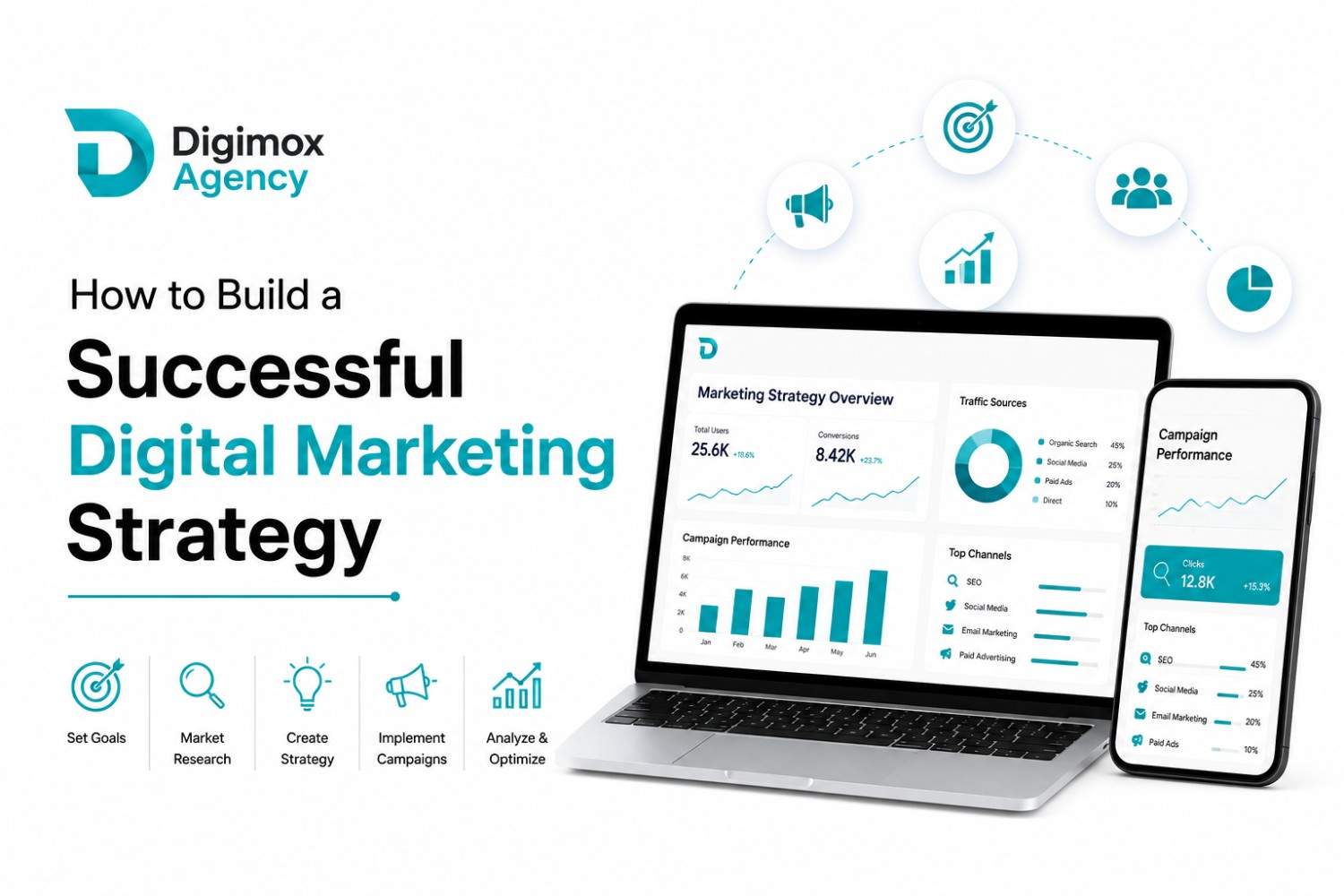
Most businesses don’t struggle with digital marketing because they lack tools or budget. They struggle because they never built a real digital marketing strategy in the first place just a rotating list of tactics tried in isolation, without a clear plan connecting them to actual business goals.
A strong digital marketing strategy changes that. It gives every campaign, blog post, and ad a reason to exist, tied back to specific outcomes like revenue, leads, or brand awareness. Without one, marketing becomes reactive: chasing trends, copying competitors, and hoping something sticks.
This guide walks through how to build a successful digital marketing strategy from the ground up — covering goal-setting, audience research, channel selection, content planning, budgeting, and measurement. Whether you’re building your first digital marketing plan or refining an existing one, the framework here applies whether you’re a solo founder, a small business owner, or part of a larger marketing team.
What a Digital Marketing Strategy Actually Is
A digital marketing strategy is the overarching plan that defines who you’re trying to reach, what you want them to do, and which channels and messages will get them there. It sits above individual campaigns a digital marketing campaign is one execution of the strategy, not the strategy itself.
Think of it this way: your digital marketing plan is the map, and each campaign is a single route on that map. Without the map, you might still reach a destination occasionally, but you’ll waste time, money, and effort getting there.
A complete digital marketing strategy typically defines:
- Business and marketing objectives
- Target audience and buyer persona details
- Core marketing channels (SEO, social, email, paid ads, content)
- Messaging and brand positioning
- Budget allocation across channels
- KPIs and how success will be measured
Why Businesses Need a Documented Strategy, Not Just Tactics
It’s tempting to skip straight to execution posting on social media, running a few ads, sending an email blast without stepping back to build an actual digital marketing strategy first. This is one of the most common reasons marketing efforts underperform.
A documented strategy forces clarity. It answers questions like: Which marketing channels deserve the biggest share of budget? What does success actually look like in 90 days? Which audience segment is most valuable to acquire?
Without that clarity, teams end up running disconnected tactics a boosted Instagram post here, a Google Ads campaign there with no shared thread tying them to business growth. A written digital marketing strategy, even a simple one-page version, keeps every channel decision anchored to the same goals.
Set Clear Marketing Objectives and SMART Goals
Every effective digital marketing strategy starts with objectives that are specific, measurable, achievable, relevant, and time-bound the SMART goals framework. Vague goals like “get more traffic” or “grow our brand” don’t give a team enough direction to prioritize channels or measure progress.
Instead, marketing objectives should look like:
- Increase organic traffic by 30% within six months
- Generate 200 qualified leads per month through paid and organic channels
- Improve email conversion rate by 15% over the next quarter
- Reduce cost per acquisition by 20% across paid campaigns
These goals should also connect to broader marketing objectives around brand awareness, customer acquisition, and revenue. A digital marketing strategy built around SMART goals gives every subsequent decision channel selection, content topics, ad spend a clear filter to run through.
Understand Your Target Audience and Buyer Persona
No digital marketing strategy works without a clear picture of who it’s built for. This starts with defining your target audience: demographics, pain points, buying behavior, and where they spend time online.
From there, build out a detailed buyer persona a semi-fictional representation of your ideal customer based on research and real data rather than assumptions. A strong buyer persona typically includes:
- Job title, industry, or life stage
- Core challenges and goals
- Preferred content formats and platforms
- Objections that typically delay a purchase decision
- Where they sit in the customer journey when they first encounter your brand
Mapping the customer journey from initial awareness through consideration to decision helps determine which messaging and marketing channels matter most at each stage. A digital marketing strategy that ignores this mapping tends to push the same message to everyone, regardless of where they actually are in that journey.
Conduct Market Research and Competitor Analysis
Before choosing channels or writing a single piece of content, thorough market research should inform the direction of the entire digital marketing strategy. This includes understanding industry trends, customer expectations, and where competitors are winning or falling short.
A structured competitor analysis should look at:
- Which marketing channels competitors are prioritizing
- Their apparent content strategy and publishing frequency
- Messaging and positioning in their advertising
- Gaps in their customer experience that your business could address
Running a simple SWOT analysis strengths, weaknesses, opportunities, threats alongside this research helps clarify where your business has a genuine competitive advantage versus where it needs to catch up. This step is often skipped in favor of jumping straight to execution, but it’s one of the most valuable investments early in building a digital marketing strategy.
Choose the Right Digital Marketing Framework
A digital marketing framework gives structure to how strategy translates into action. Popular frameworks include the marketing funnel (awareness, consideration, decision), the flywheel model, and the RACE framework (reach, act, convert, engage).
Choosing a framework isn’t about picking the “correct” one it’s about picking the structure that matches how your business actually sells. A B2B company with a long sales cycle will likely lean on a marketing funnel strategy with heavy content and lead nurturing, while an e-commerce marketing brand may benefit more from a flywheel approach focused on repeat purchases and referrals.
Whatever framework you choose, it should map clearly onto your sales funnel and give every marketing channel a defined role top-of-funnel awareness, mid-funnel consideration, or bottom-funnel conversion.
Build Your Content Strategy and Content Calendar
Content is the connective tissue across nearly every channel in a digital marketing strategy, from SEO to social media to email campaigns. A strong content strategy starts with understanding search intent what your audience is actually looking for at each stage of their journey rather than guessing at topics.
Core components of a content strategy include:
- Blog marketing built around keyword research and search intent
- Video marketing for platforms like YouTube and TikTok Marketing formats
- Social media content tailored to each platform’s audience and format expectations
- Landing pages designed specifically for conversion, not general information
- Email campaigns that nurture leads with relevant, timed content
A content calendar keeps all of this organized and consistent, mapping out what gets published, where, and when. Without one, content production tends to become reactive and inconsistent which undermines both SEO performance and audience trust over time.
Select Your Marketing Channels
Not every business needs to be active on every platform. Choosing the right marketing channels depends on where your target audience actually spends time and which channels align with your marketing objectives.
Common channels within a digital marketing strategy include:
- SEO strategy improving organic traffic through on-page SEO, technical SEO, and off-page SEO like backlink building
- Social media marketing strategy building brand awareness and engagement through platforms like LinkedIn Marketing, TikTok Marketing, and YouTube Marketing
- Email marketing strategy nurturing leads and retaining customers through targeted email campaigns
- PPC marketing strategy driving immediate traffic and conversions through Google Ads and Meta Ads
- Local SEO critical for businesses relying on nearby customers, such as service-area or brick-and-mortar businesses
Most effective strategies combine several of these into an omnichannel marketing strategy, where each channel reinforces the others rather than operating in isolation.
Plan Your Digital Marketing Campaign and Budget
Once channels are selected, each digital marketing campaign needs a defined budget, timeline, and success metric. Budget allocation should reflect where your target audience is most active and where past performance data shows the strongest return on investment.
A practical approach to budgeting includes:
- Allocating a baseline budget to proven channels with a track record of ROI
- Setting aside a smaller testing budget for emerging channels or formats
- Reviewing cost per acquisition and cost per click regularly to reallocate spend toward top performers
- Building in flexibility to shift budget mid-campaign based on early results
This is also where a marketing automation strategy becomes valuable automating repetitive tasks like lead nurturing sequences and ad bid adjustments frees up budget and time for strategic decision-making rather than manual execution.
Set Up Marketing Analytics and KPIs
No digital marketing strategy is complete without a clear plan for measurement. Key performance indicators, or KPIs, should tie directly back to the SMART goals established at the start of the process.
Common KPIs to track include:
- Organic traffic and keyword rankings for SEO performance
- Click-through rate (CTR) and cost per click (CPC) for paid campaigns
- Conversion rate across landing pages and email campaigns
- Customer lifetime value (CLV) and cost per acquisition (CPA) for long-term profitability
- Return on investment (ROI) across the entire digital marketing strategy
Tools like Google Analytics 4 (GA4) and Google Search Console provide the raw data needed to track these metrics, while regular A/B testing helps refine messaging, design, and offers over time. Reviewing this data monthly not just at the end of a campaign allows for course correction before a channel underperforms for too long.
Digital Marketing Strategy Examples by Business Type
Different business types benefit from different digital marketing strategy examples:
- Small business: A local service business might prioritize local SEO, Google Business Profile optimization, and a modest paid ads budget targeting nearby customers.
- E-commerce brand: An online store may lean heavily on Meta Ads, email marketing strategy for cart recovery, and influencer partnerships to drive repeat purchases.
- B2B company: A B2B marketing strategy often centers on LinkedIn Marketing, gated content for lead generation, and a longer email nurture sequence supporting a multi-touch sales funnel.
- Startup: Early-stage startups typically prioritize organic content and SEO strategy to build traffic without heavy ad spend, layering in paid channels once product-market fit is clearer.
These examples highlight why there’s no single universal digital marketing strategy template the right plan depends on business model, audience, and available budget.
Digital Marketing Strategy Checklist
Use this checklist as a quick reference when building or auditing your plan:
- Marketing objectives defined using SMART goals
- Target audience and buyer persona documented
- Market research and competitor analysis completed
- Digital marketing framework selected
- Content strategy and content calendar in place
- Marketing channels chosen based on audience behavior
- Budget allocated across channels with room for testing
- KPIs and analytics tracking set up before launch
- Review cadence scheduled for ongoing optimization
Comparison Table: Digital Marketing Channels at a Glance
| Channel | Best For | Typical KPI | Time to Results |
| SEO Strategy | Long-term organic traffic | Organic traffic, keyword rankings | Months |
| Content Marketing | Brand authority, lead nurturing | Engagement, organic traffic | Weeks to months |
| Social Media Marketing | Brand awareness, engagement | CTR, engagement rate | Weeks |
| Email Marketing | Lead nurturing, retention | Conversion rate, CLV | Weeks |
| PPC / Google Ads | Immediate traffic and leads | CPC, CPA, conversion rate | Days to weeks |
| Local SEO | Nearby customer acquisition | Local search visibility | Weeks to months |
This comparison makes it easier to see how each channel fits into a broader digital marketing strategy organic channels build long-term equity, while paid channels deliver faster, more immediate results.
Common Mistakes That Derail a Digital Marketing Strategy
Even well-intentioned plans can fall apart due to a few recurring mistakes:
- Skipping the research phase. Jumping straight into content or ads without market research or competitor analysis often leads to wasted spend.
- Setting vague goals. Objectives that aren’t specific or measurable make it impossible to know whether the strategy is working.
- Spreading budget too thin. Trying to be active on every channel at once often means no channel gets enough investment to actually perform.
- Ignoring the customer journey. Sending the same message to everyone regardless of where they are in the funnel reduces conversion rates.
- Not reviewing data regularly. Waiting until the end of a quarter to check performance means missed opportunities to course-correct earlier.
The Role of AI in Digital Marketing Strategy
AI in digital marketing has become a meaningful part of how modern strategies get built and executed. Predictive analytics can forecast which audience segments are most likely to convert, while automation tools handle repetitive tasks like ad bid adjustments and email sequencing.
An AI-powered digital marketing strategy doesn’t replace the fundamentals covered in this guide audience research, goal-setting, and channel selection still require human judgment. But AI tools can accelerate execution, surface insights faster, and support more precise data-driven marketing decisions across every stage of the funnel.
17. Conclusion
Building a successful digital marketing strategy isn’t about chasing every new platform or tactic it’s about creating a clear, connected plan that ties your marketing objectives to real business outcomes. From setting SMART goals and understanding your target audience to selecting the right marketing channels and tracking the right KPIs, every step in this guide builds toward a digital marketing strategy that actually drives measurable growth.
The businesses that see the strongest results aren’t necessarily the ones with the biggest budgets they’re the ones with the clearest strategy behind every decision. A well-documented digital marketing strategy turns scattered tactics into a coordinated system, where SEO, content, social, email, and paid advertising all work toward the same goal.
Call to Action: Start by writing down your top three marketing objectives for the next quarter, then map them against the steps in this guide. Even a simple, one-page digital marketing strategy is a stronger foundation than none at all and it’s the first real step toward sustainable business growth.