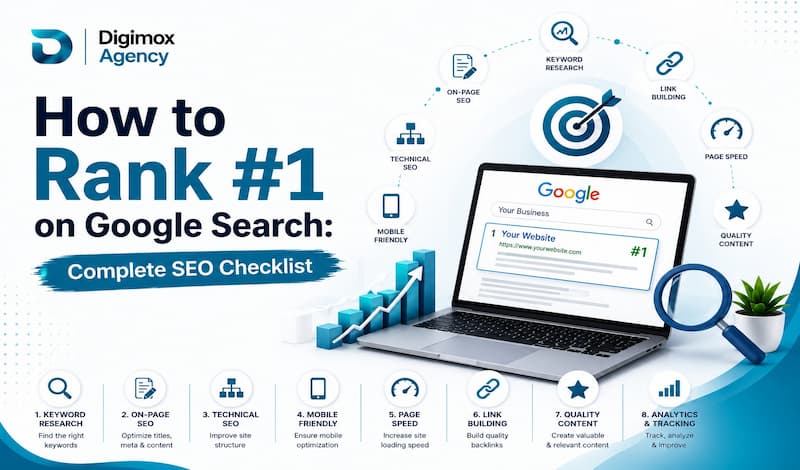
If you have ever typed a question into the search bar and wondered how certain websites always show up first, you already understand why so many business owners obsess over how to rank #1 on Google Search. Ranking at the top of search results isn’t luck. It’s the outcome of a structured, repeatable process that combines technical precision, quality content, and consistent authority building.
At DigiMox marketing, we’ve helped businesses across different industries move from page three to page one by following a checklist-driven approach rather than guesswork. This guide breaks down exactly how to rank #1 on Google using the same framework we apply for our own clients no shortcuts, no black-hat tricks, just a proven system built on real Google ranking factors.
By the end of this article, you’ll have a complete, actionable SEO checklist covering keyword research, on-page SEO, technical SEO, local SEO, off-page SEO, and content optimization everything you need to improve your search visibility and grow organic traffic sustainably.
Why Ranking #1 on Google Matters
Before diving into how to rank #1 on Google Search, it helps to understand why the top spot is worth chasing. Studies consistently show that the first organic result on Google captures the largest share of clicks, while positions further down see a steep drop-off in click-through rate (CTR). This means two websites can target the same keyword, yet the one ranking #1 will receive dramatically more organic traffic, leads, and conversions.
Ranking #1 also builds trust. Users associate top rankings with credibility, which directly impacts your domain authority and brand perception. In competitive industries including real estate, e-commerce, and local services search visibility often determines who wins the customer, not just who has the better product.
This is exactly why understanding how to rank #1 on Google isn’t optional anymore. It’s a core business skill, whether you manage SEO in-house or work with an agency like DigiMox marketing.
Understanding Google Ranking Factors
Google uses hundreds of Google ranking factors to determine which pages deserve the top spots. While the exact algorithm is private, years of testing and official Google documentation point to a few pillars that consistently matter:
- Relevance Does your content match the search intent behind the query?
- Content quality Is it high-quality content that genuinely helps the user?
- E-E-A-T Does your page demonstrate Experience, Expertise, Authoritativeness, and Trustworthiness?
- Technical health Can Google crawl, render, and index your site without friction?
- User experience (UX) Is the site fast, mobile-friendly, and easy to navigate?
- Authority signals Do other reputable sites link back to you through backlinks?
Every section of this SEO checklist ties back to one or more of these pillars. Understanding how to rank #1 on Google means treating these factors as a system, not isolated tasks.
Keyword Research Guide
Every successful SEO strategy starts with a solid keyword research guide. Without knowing what your audience is actually searching for, you’re optimizing blindly.
How to Approach Keyword Research
- Identify your primary keyword and supporting secondary keywords for each page.
- Use long-tail keywords to capture more specific, lower-competition search intent.
- Group related terms into topic clusters built around a central pillar content page.
- Study semantic SEO and entity SEO Google understands topics, not just exact-match phrases, so related concepts matter as much as the keyword itself.
- Analyze competitor pages ranking on page one to understand content gaps.
Recommended SEO Tools for Keyword Research
Tools like Ahrefs, SEMrush, and Google Search Console are essential for uncovering keyword opportunities, search volume, and ranking difficulty. Google Search Console in particular shows you the exact queries already driving impressions to your site often revealing “easy win” keywords you’re already close to ranking for.
A well-executed keyword research phase lays the foundation for how to rank #1 on Google because every later step content, on-page SEO, and link building depends on targeting the right terms from the start.
On-Page SEO Checklist
Once you know what to target, the next step in learning how to rank #1 on Google is mastering on-page SEO. This is where you directly influence how search engines interpret each page.
Core On-Page SEO Checklist Items
- Meta title optimization Include your primary keyword near the beginning, keep it under 60 characters, and make it click-worthy.
- Meta description optimization Write a compelling 150–160 character summary that encourages clicks and naturally includes your target keyword.
- URL structure Keep URLs short, descriptive, and keyword-relevant (avoid long strings of numbers or parameters).
- Header tags (H1, H2, H3) Use one clear H1 heading per page and organize subtopics with H2/H3 tags for readability and semantic structure.
- Keyword mapping Assign each keyword or keyword cluster to one specific page to avoid keyword cannibalization.
- Image SEO Compress images, use descriptive file names, and add alt text that describes the image while incorporating relevant keywords naturally.
- Canonical tags Prevent duplicate content issues by specifying the preferred version of a page.
On-page SEO isn’t a one-time task. It should be revisited during every website SEO audit to make sure new pages follow the same standards.
Content Optimization for Search Intent
Content is still the backbone of how to rank #1 on Google. But writing more content isn’t the goal writing the right content is.
Matching Search Intent
Google categorizes most queries into four intent types: informational, navigational, commercial, and transactional. Before writing, ask what the searcher actually wants to accomplish. A page optimized for the wrong intent will struggle to rank, no matter how well-written it is.
Principles of SEO Content Writing
- Lead with the most valuable information don’t bury the answer.
- Write in a natural, conversational tone using active voice.
- Break up content with short paragraphs, bullet points, and subheadings.
- Naturally weave in semantic keywords and related entities so the page reads as topically comprehensive.
- Update older content regularly to keep it accurate and aligned with the latest Google algorithm updates.
Helpful Content and E-E-A-T
Google’s helpful content systems reward pages written for people first, not search engines. Demonstrating E-E-A-T through author bios, case studies, original data, or first-hand experience signals trustworthiness. This is especially important in industries like finance, health, and real estate, where accuracy directly affects users’ decisions.
Strong content optimization, paired with genuine expertise, is one of the most sustainable ways to achieve how to rank #1 on Google rankings that don’t disappear after the next algorithm update.
Technical SEO Checklist
Even the best content won’t rank if Google can’t crawl and index it properly. This is where a technical SEO checklist becomes critical.
Key Technical SEO Checklist Items
- Crawlability Ensure important pages aren’t blocked by mistake and that your site structure allows search engines to discover new content easily.
- Indexing Regularly check Google Search Console’s Index Coverage report to confirm pages are indexed correctly.
- XML sitemap Submit an updated XML sitemap so search engines can find and prioritize your important pages.
- Robots.txt Configure your robots.txt file carefully to avoid accidentally blocking valuable pages from being crawled.
- HTTPS security A secure site (HTTPS) is a baseline trust and ranking signal.
- Broken links Fix broken internal and external links, which hurt both UX and crawl efficiency.
- Crawl budget For larger sites, manage crawl budget by removing thin or duplicate pages that waste Google’s crawling resources.
A recurring technical website audit ideally monthly for competitive sites helps catch issues before they silently damage your rankings.
Core Web Vitals and Page Speed Optimization
Website performance directly affects both rankings and conversions. Google’s Core Web Vitals measure real-world user experience through three key metrics:
- Largest Contentful Paint (LCP) How quickly the main content loads.
- Interaction to Next Paint (INP) How responsive the page feels to user interactions.
- Cumulative Layout Shift (CLS) How visually stable the page is while loading.
Page Speed Optimization Tips
- Compress and lazy-load images.
- Minimize unused JavaScript and CSS.
- Use a content delivery network (CDN) for faster global load times.
- Enable browser caching.
- Choose reliable, fast hosting.
Improving Core Web Vitals isn’t just a ranking exercise it also reduces bounce rate and improves conversion rate optimization (CRO), making it one of the highest-ROI parts of any SEO checklist.
Step 6: Mobile-Friendly Website Optimization
With mobile-first indexing, Google primarily uses the mobile version of your site for ranking and indexing. A mobile-friendly website is no longer optional.
- Use responsive design that adapts to all screen sizes.
- Ensure tap targets (buttons, links) are appropriately sized and spaced.
- Avoid intrusive pop-ups that block content on mobile.
- Test regularly using Google’s mobile-friendly testing tools.
Mobile SEO also ties directly into voice search optimization, since most voice queries happen on mobile devices and smart speakers. As more searches shift toward conversational, question-based queries, optimizing content for natural language helps capture this growing segment and increasingly overlaps with AI search optimization as AI-powered search experiences become more common.
Schema Markup and Rich Results
Structured data helps Google understand your content more precisely, which can unlock rich results like star ratings, FAQs, and product details directly in the SERP.
Common Schema Markup Types
- Article schema for blog content
- FAQPage schema for FAQ sections
- LocalBusiness schema for local SEO
- Product and Review schema for e-commerce
- BreadcrumbList schema for site navigation
Implementing schema markup increases your chances of earning featured snippets and rich results, both of which improve click-through rate even without a #1 ranking. Combined with strong on-page SEO, structured data is a key technical lever for how to rank #1 on Google in competitive SERPs.
Internal Linking and Site Architecture
Internal linking distributes authority across your site and helps both users and search engines navigate your content.
- Link from high-authority pages to newer or underperforming pages.
- Use descriptive, keyword-relevant anchor text (avoid generic “click here” links).
- Build topic clusters by linking supporting articles back to a central pillar content page.
- Maintain a logical site architecture so no important page is more than a few clicks from the homepage.
Good internal SEO practices also help search engines understand keyword mapping across your site, reinforcing topical relevance for your most important pages.
Off-Page SEO and Link Building Strategies
On-page and technical SEO get your site rank-ready, but off-page SEO builds the authority needed to actually compete for top rankings.
Effective Link Building Strategies
- Guest posting on relevant, reputable industry websites.
- Digital PR earning backlinks through newsworthy content, original research, or expert commentary.
- Resource link building creating genuinely useful tools, guides, or data that other sites want to reference.
- Local citations getting listed on relevant directories and industry-specific platforms.
- Broken link building finding broken external links on other sites and suggesting your content as a replacement.
External links from authoritative, topically relevant domains remain one of the strongest ranking signals. Focus on earning backlinks naturally through valuable content rather than pursuing low-quality, spammy links, which can trigger penalties under Google’s spam policies.
Step 10: Local SEO Checklist
For businesses serving specific cities or regions, local search optimization is essential to how to rank #1 on Google for “near me” and location-based queries.
Local SEO Checklist Essentials
- Claim and fully optimize your Google Business Profile.
- Keep your Name, Address, and Phone number (NAP) consistent across all directories.
- Collect and respond to customer reviews consistently.
- Build local citations on relevant business directories.
- Create location-specific landing pages for multi-location businesses.
- Use LocalBusiness schema markup to reinforce local relevance.
Local SEO is particularly important for service-based industries like real estate, healthcare, and home services, where users often search with clear geographic intent.
SEO Tools You Need for a Website SEO Audit
A reliable SEO checklist is only as good as the tools used to execute it. Here are the essentials for any thorough website SEO audit:
- Google Search Console Monitor indexing, search performance, and technical errors directly from Google.
- Google Analytics 4 (GA4) Track organic traffic, user behavior, bounce rate, and conversions.
- Ahrefs / SEMrush Conduct keyword research, backlink analysis, and competitor audits.
- Screaming Frog Crawl your site to identify broken links, duplicate content, and technical issues at scale.
- Bing Webmaster Tools Optimize for Bing’s search engine alongside Google to capture additional organic search traffic.
Combining these tools allows for consistent SEO performance monitoring, so issues are caught early rather than after rankings drop.
Comparison Table: SEO Ranking Factors by Impact
| SEO Factor Category | Examples | Relative Ranking Impact | Typical Time to See Results |
| Content Quality & Search Intent | High-quality content, E-E-A-T, helpful content | Very High | 2–4 months |
| Technical SEO | Crawlability, indexing, XML sitemap, robots.txt | High (foundational) | 2–6 weeks |
| Core Web Vitals & Page Speed | LCP, INP, CLS, mobile SEO | Medium–High | 2–8 weeks |
| On-Page SEO | Meta titles, headers, keyword mapping, image SEO | Medium–High | 3–6 weeks |
| Off-Page SEO / Backlinks | Guest posts, digital PR, link building strategies | Very High | 3–6 months |
| Local SEO | Google Business Profile, citations, reviews | High (for local queries) | 4–8 weeks |
| Schema Markup / Structured Data | FAQPage, LocalBusiness, Article schema | Medium (CTR-focused) | 2–4 weeks |
| Internal Linking & Site Architecture | Topic clusters, anchor text, pillar content | Medium | 4–6 weeks |
This comparison table illustrates why how to rank #1 on Google requires a balanced strategy — no single factor works in isolation, and neglecting even one category (like technical SEO or Core Web Vitals) can hold back an otherwise strong page.
Common Mistakes That Stop You From Ranking #1
- Targeting keywords with no real search intent match.
- Ignoring technical website audit results for months at a time.
- Publishing thin, duplicate content instead of comprehensive pillar content.
- Over-optimizing anchor text, which can look manipulative to Google.
- Neglecting mobile SEO and page speed optimization.
- Building low-quality backlinks instead of focused link building strategies.
- Failing to track SEO performance monitoring metrics like organic traffic, CTR, and bounce rate over time.
Avoiding these mistakes is often just as important as following SEO best practices correctly.
How Long Does It Take to Rank #1 on Google?
There’s no fixed timeline for how to rank #1 on Google it depends on competition, domain authority, content quality, and consistency. Generally:
- New websites may take 6–12 months to build enough authority for top rankings on competitive terms.
- Established sites with strong domain authority can rank for new content in weeks with solid on-page SEO and internal linking.
- Local SEO results often appear faster than national or global organic search rankings.
Patience combined with consistent execution of this SEO checklist produces far more sustainable results than chasing quick, risky shortcuts.
Conclusion
Learning how to rank #1 on Google isn’t about chasing a single trick it’s about consistently executing across keyword research, on-page SEO, technical SEO, content optimization, off-page SEO, and local SEO. Each piece of this SEO checklist reinforces the others, and skipping even one category can quietly limit your results.
The businesses that succeed long-term treat SEO as an ongoing system rather than a one-time project. Whether you’re optimizing a single landing page or managing a full-site strategy, the fundamentals covered here remain the most reliable path to how to rank #1 on Google and sustain that position against competitors.
Call to Action
Ready to put this SEO checklist into action but not sure where to start? The team at DigiMox marketing specializes in turning strategies like this into measurable organic traffic growth. Get in touch with DigiMox Agency today for a complete website SEO audit and a custom roadmap to help your site rank #1 on Google.